Strategic Price Anchoring: The “Decoy” or “Extreme Anchor” Strategy
One advanced price anchoring technique is intentionally introducing an extremely high-priced option (the “decoy”) that is not meant to sell, but rather to make all other plans look much more reasonable, accessible, and attractive in comparison.
This pricing psychology is commonly used in subscription services, SaaS, luxury goods, and high-ticket sales to increase the likelihood that customers select the intended middle or premium offer instead of the cheapest one.
1️⃣ How the “Extreme Anchor” Works
- You introduce a super-premium, high-priced package that is not meant to sell but creates a psychological contrast.
- This makes the standard and premium plans appear like excellent value in comparison.
- Customers, when faced with the extreme price, naturally gravitate toward the next-best, more “reasonable” offer (often the 12-month plan).
2️⃣ How This Applies to Selling 3, 6, and 12-Month Subscription Plans
Let’s assume our standard pricing structure looks like this:

3️⃣ Applying the “Extreme Price Anchor” Strategy
Now, let’s introduce a super-premium offer that is deliberately overpriced to shift customer perception:
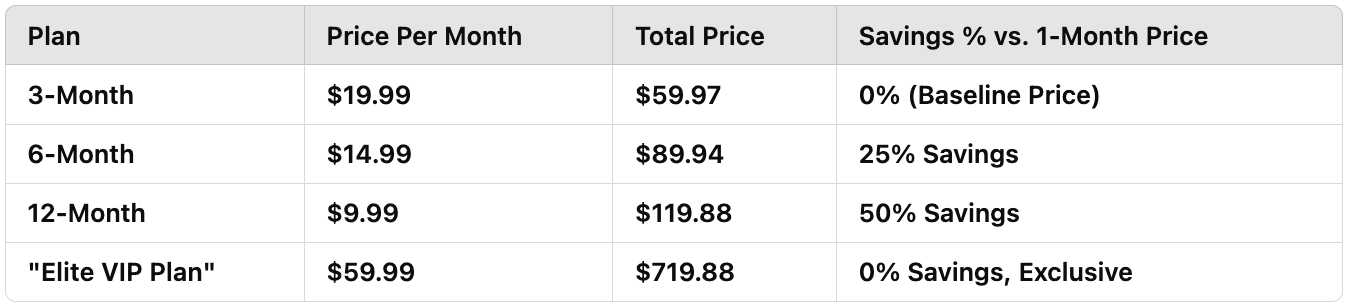
➡️ The VIP Plan acts as the extreme anchor. It is so outrageously high, most customers will instantly disregard it—but in doing so, they will naturally gravitate toward the 12-month plan, which now seems incredibly affordable and the best value.
4️⃣ The Psychology Behind This Tactic
✅ The Contrast Effect:
- By introducing a very expensive plan, you change how customers perceive value.
- The 12-month plan suddenly looks like an incredible bargain in comparison.
✅ Fear of Overpaying (Loss Aversion):
- Customers don’t want to overpay for the 3-month or 6-month plans, but they also don’t want to pay a ridiculously high price for the VIP package.
- They default to the “safe” middle-ground option (the 12-month plan).
✅ The Decoy Effect:
- Customers often use the most expensive option as a benchmark for what’s reasonable.
- Since the VIP plan is unrealistic, it nudges them toward the plan that feels like the “best deal”—the 12-month plan.
✅ Premium Perception Boost:
- The “Elite VIP Plan” (even though it’s overpriced) makes our product feel more premium overall.
- It subtly reinforces that our service is valuable and worth a long-term commitment.
5️⃣ Real-World Examples of the Extreme Price Anchor in Action
✅ Apple Mac Pro ($50,000+ Model)
- Apple intentionally includes a maxed-out Mac Pro configuration that costs over $50,000, making their $5,999 base model feel like a steal.
✅ Streaming Services & SaaS
- Many subscription services include a $499+/year enterprise plan that no one buys, but it makes the standard $99/year plan feel like an incredible value.
✅ Wine & Restaurants
- Many upscale restaurants include a single, ridiculously priced bottle of wine ($500+) on the menu—not because they expect to sell it, but because it makes the $80 bottle seem “reasonable.”
✅ Tinder’s Premium Pricing (Gold, Platinum, Plus)
- Tinder offers Tinder Platinum for $39.99/month, making Tinder Gold at $19.99/month seem like a great deal.
6️⃣ How to Implement This for Our Subscription Model
1. Create an “Elite VIP” Subscription Package
- Price: $59.99/month ($719.88/year)
- Positioning: Exclusive, for high-end talent, premium support
- Reality: Not expected to sell much—just a price anchor
- Effect: Makes the 12-month plan look incredibly affordable
2. Emphasize the Best-Value Option (12-Month Plan)
- Label it “Most Popular” or “Best Value”
- Highlight the savings (50% off vs. 3-month)
- Use visual design cues to draw attention to it
7️⃣ Conclusion
Using the Extreme Price Anchor Strategy, we can boost conversions by psychologically directing customers toward the 12-month plan. The “Elite VIP Plan” will act as a price reference, subtly guiding users to the long-term subscription that generates the most revenue.
This strategy leverages cognitive biases and has been successfully used by top-tier SaaS, subscription businesses, and e-commerce brands to increase sales, maximize perceived value, and drive long-term commitments.
 IgorReiant.com