Archive
Strategic Price Anchoring: The “Decoy” or “Extreme Anchor” Strategy
One advanced price anchoring technique is intentionally introducing an extremely high-priced option (the “decoy”) that is not meant to sell, but rather to make all other plans look much more reasonable, accessible, and attractive in comparison.
This pricing psychology is commonly used in subscription services, SaaS, luxury goods, and high-ticket sales to increase the likelihood that customers select the intended middle or premium offer instead of the cheapest one.
1️⃣ How the “Extreme Anchor” Works
- You introduce a super-premium, high-priced package that is not meant to sell but creates a psychological contrast.
- This makes the standard and premium plans appear like excellent value in comparison.
- Customers, when faced with the extreme price, naturally gravitate toward the next-best, more “reasonable” offer (often the 12-month plan).
2️⃣ How This Applies to Selling 3, 6, and 12-Month Subscription Plans
Let’s assume our standard pricing structure looks like this:

3️⃣ Applying the “Extreme Price Anchor” Strategy
Now, let’s introduce a super-premium offer that is deliberately overpriced to shift customer perception:
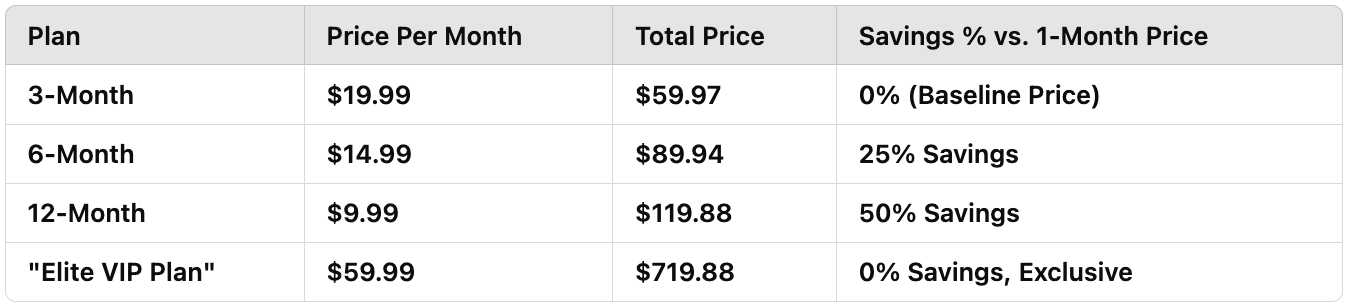
➡️ The VIP Plan acts as the extreme anchor. It is so outrageously high, most customers will instantly disregard it—but in doing so, they will naturally gravitate toward the 12-month plan, which now seems incredibly affordable and the best value.
4️⃣ The Psychology Behind This Tactic
✅ The Contrast Effect:
- By introducing a very expensive plan, you change how customers perceive value.
- The 12-month plan suddenly looks like an incredible bargain in comparison.
✅ Fear of Overpaying (Loss Aversion):
- Customers don’t want to overpay for the 3-month or 6-month plans, but they also don’t want to pay a ridiculously high price for the VIP package.
- They default to the “safe” middle-ground option (the 12-month plan).
✅ The Decoy Effect:
- Customers often use the most expensive option as a benchmark for what’s reasonable.
- Since the VIP plan is unrealistic, it nudges them toward the plan that feels like the “best deal”—the 12-month plan.
✅ Premium Perception Boost:
- The “Elite VIP Plan” (even though it’s overpriced) makes our product feel more premium overall.
- It subtly reinforces that our service is valuable and worth a long-term commitment.
5️⃣ Real-World Examples of the Extreme Price Anchor in Action
✅ Apple Mac Pro ($50,000+ Model)
- Apple intentionally includes a maxed-out Mac Pro configuration that costs over $50,000, making their $5,999 base model feel like a steal.
✅ Streaming Services & SaaS
- Many subscription services include a $499+/year enterprise plan that no one buys, but it makes the standard $99/year plan feel like an incredible value.
✅ Wine & Restaurants
- Many upscale restaurants include a single, ridiculously priced bottle of wine ($500+) on the menu—not because they expect to sell it, but because it makes the $80 bottle seem “reasonable.”
✅ Tinder’s Premium Pricing (Gold, Platinum, Plus)
- Tinder offers Tinder Platinum for $39.99/month, making Tinder Gold at $19.99/month seem like a great deal.
6️⃣ How to Implement This for Our Subscription Model
1. Create an “Elite VIP” Subscription Package
- Price: $59.99/month ($719.88/year)
- Positioning: Exclusive, for high-end talent, premium support
- Reality: Not expected to sell much—just a price anchor
- Effect: Makes the 12-month plan look incredibly affordable
2. Emphasize the Best-Value Option (12-Month Plan)
- Label it “Most Popular” or “Best Value”
- Highlight the savings (50% off vs. 3-month)
- Use visual design cues to draw attention to it
7️⃣ Conclusion
Using the Extreme Price Anchor Strategy, we can boost conversions by psychologically directing customers toward the 12-month plan. The “Elite VIP Plan” will act as a price reference, subtly guiding users to the long-term subscription that generates the most revenue.
This strategy leverages cognitive biases and has been successfully used by top-tier SaaS, subscription businesses, and e-commerce brands to increase sales, maximize perceived value, and drive long-term commitments.
Price Anchoring Strategy for Online Subscription Services
Price anchoring is a psychological pricing strategy that helps guide customers toward making a desired purchasing decision by strategically presenting multiple options. In the context of an online subscription service with 3, 6, and 12-month plans, price anchoring is used to maximize conversions and revenue while influencing perceived value.
1️⃣ How Price Anchoring Works
Price anchoring works by presenting multiple pricing options, where one serves as a “reference price” (the anchor) that makes the intended offer (often the 12-month plan) appear more attractive and valuable.
The key goal is to structure pricing in a way that:
- Encourages users to select the most profitable option (usually the 12-month plan).
- Creates a perception of higher value per dollar spent on longer commitments.
- Discourages selection of lower-value options (e.g., the 3-month plan) by making them appear less cost-effective.
2️⃣ Pricing Strategy for a 3-Tier Subscription Model
A well-structured price anchoring strategy for a 3-plan subscription model (3, 6, and 12 months) typically follows this psychological pricing structure:

- The 3-month plan serves as a high anchor price, making the other plans look like a better deal.
- The 6-month plan is a compromise choice, placed there to reinforce the attractiveness of the 12-month plan while capturing users who are hesitant about long-term commitment.
- The 12-month plan is designed to appear as the best value, with the lowest price per month and the most significant discount.
3️⃣ The Psychology Behind Price Anchoring
- Reference Dependence (The “Anchor” Effect)
- Customers rely on a reference point to evaluate prices. The 3-month plan acts as this reference point, making the 6-month and 12-month plans look more cost-effective.
- The Compromise Effect
- Many consumers instinctively avoid the cheapest and most expensive options, opting for the middle choice. However, when the price difference between the middle and highest option is small, users are nudged toward selecting the 12-month plan.
- Perceived Value & Cost Savings
- When customers see “50% savings” on the 12-month plan, they perceive it as a huge discount rather than just a pricing strategy.
- Even though they are committing more money upfront, they feel they are getting twice the value for the same price.
- Loss Aversion
- If users choose the shorter plan, they subconsciously feel like they are losing out on the savings from the longer plan.
- This is a powerful motivator, as people are twice as likely to avoid losses as they are to seek gains.
4️⃣ Real-World Examples of Price Anchoring
✅ Example 1: Netflix & Spotify (Monthly vs. Annual Savings)
- Many streaming services use a monthly vs. annual pricing strategy:
* Monthly Plan: $12.99/month → $155.88 per year
* Annual Plan: $119.99 (One-Time) → 20% Savings - The monthly price acts as an anchor that makes the annual subscription look like a much better deal.
✅ Example 2: Adobe Creative Cloud
- Monthly Plan: $79.99/month (No contract)
- Annual Plan (Paid Monthly): $52.99/month → 33% savings
- Annual Plan (Paid in Full): $599.88/year → 50% savings
- Adobe uses high monthly pricing to push users toward long-term commitments with heavy discounts.
✅ Example 3: Match.com & Dating Apps
- 1-Month Plan: $59.99/month
- 6-Month Plan: $26.99/month
- 12-Month Plan: $20.99/month
- The one-month price sets an anchor, making the 12-month plan look like an incredible deal.
5️⃣ How to Optimize Price Anchoring for a Subscription Service
🔹 Set a strong anchor price → The shortest plan should have the highest per-month cost to make longer-term plans more attractive.
🔹 Ensure the longest plan has the best-perceived value → Use a compelling discount like 40-50% off compared to the shortest plan.
🔹 Use psychological pricing (e.g., $9.99 instead of $10.00) → Small price reductions influence decisions.
🔹 Highlight savings percentages → Reinforce the discount customers are getting by choosing a longer-term plan.
🔹 Emphasize exclusivity → Phrases like “Best Deal” or “Most Popular” help nudge users toward the preferred plan.
Conclusion
Price anchoring is a powerful strategy that influences customer perception and drives higher-value conversions in a subscription business. By carefully structuring 3-month, 6-month, and 12-month plans, companies can steer customers toward longer commitments while ensuring pricing remains competitive and profitable.
The Essential Guide for Startup Founders to Build an Effective Social Media Presence
For most startup founders, building a social presence is a necessity. Social media platforms help research audiences, drive growth, build brands, and communicate. However, creating an effective social media strategy is challenging due to constantly changing algorithms and trends.
Setting Realistic Goals
Before diving into social media, it’s crucial to set realistic goals that drive momentum. Consider the following:
• Role of Social Media: Is the focus on customer service, content distribution, or brand perception?
• End Game: Are you building a following for a product launch or resetting brand perceptions?
• Timeline: Set specific, short-term goals to build momentum.
Identifying Target Audiences
To avoid posting into the void, identify your target audience:
• Who are they? Are they customers, investors, or niche communities?
• Where are they located? Use analytics tools or simple methods like asking for feedback in community spaces.
• What content do they engage with? Study high-performing content and emulate successful themes.
Prioritizing Platforms
Focus on 1-2 platforms to start, as maintaining more isn’t sustainable for most founders. Consider using both brand and personal accounts to connect with your audience more effectively.
Creating Content
Post content that provides unique value, such as:
• How-to Guides
• Behind-the-Scenes Insights
• Industry Trends
• Product Updates
Experiment with different content types to find what resonates with your audience.
Adapting to Changes
Social media platforms frequently update their algorithms, affecting content visibility. Stay nimble and willing to experiment with new content types as needed.
Building Posting Cadence
Quality > Consistency > Quantity. Start with high-quality posts, then increase frequency as you gauge success. Create a backlog of evergreen content to maintain a consistent posting schedule.
Measuring Success
Track success both qualitatively and quantitatively:
• Qualitative: Monitor feedback, DMs, and overall sentiment.
• Quantitative: Track engagement, conversions, and audience growth using in-app analytics.
Encouraging Engagement
Don’t be discouraged by silent supporters—many consume content without engaging. Encourage interaction by hosting events, engaging in community management, and experimenting with different content formats.
Growing Your Social Media Presence
Effective social strategies create a growth flywheel: more engagement leads to more reach, which leads to more followers, and so on. To accelerate growth:
• Engage with your audience regularly.
• Create shareable and discussion-worthy content.
• Maintain a consistent voice across platforms.
Final Thoughts
Be focused on your niche and limit your efforts to two platforms initially. Over time, your audience will grow, and with it, your social media presence. Even small teams can build engaging feeds that resonate with their audience.
A Glimpse into a Transformative Conversation: The Power of Simplicity and Vision in Achieving Success
The realm of success, personal growth, and leadership is vast and layered. While many venture into its depths, few emerge with genuine pearls of wisdom that can illuminate the path for others. Recently, I had the privilege to conduct an interview that offered just that — invaluable insights that resonate with those who seek to transform dreams into reality.
In this enlightening conversation, we delved deep into the significance of crafting a compelling vision, setting clear goals, and how these can reshape our trajectories. A recurring theme, echoing through the dialogue, was the power of simplicity. Whether it’s in communication, solutions, or personal journeys, the essence of simplicity often holds the key to unlocking monumental challenges.
As you dive into the full interview, prepare to be inspired by the importance of embracing one’s unique journey, the magic that unfolds when simplicity takes center stage, and the undying spirit of resilience and growth. Remember, the road to success isn’t just about reaching the destination but about the growth, learning, and experiences we accumulate along the way.
Read The Full Interview with Here
Get ready to be inspired, and may these insights pave your way to greatness! 🌟🚀
Why it’s important to have diversity represented in Entertainment and it’s potential effects on our culture
Diversity in entertainment is vitally important to our culture for a variety of reasons. Representing different cultures, ethnicities, genders, and abilities in entertainment can have a significant impact on how we view and interact with each other. Here are three key reasons why it’s so important to have diversity represented in entertainment:
- Promotes Inclusivity: Having diversity in entertainment encourages viewers to appreciate the many different cultures and backgrounds that exist, and to recognize the importance of inclusivity. When people see themselves and their cultures represented in the media, it can help to validate their own experiences, and build a sense of community. This can lead to a more tolerant, understanding society, where everyone is free to express themselves.
- Creates Awareness: When diverse perspectives are seen in entertainment, it can help to create awareness of different issues and experiences. Representing a variety of characters and stories can help to educate viewers about a certain culture or topic, and can help to break down stereotypes and misinformation.
- Encourages Empathy: Seeing different perspectives in entertainment can help to encourage empathy. Viewers can gain insight into how other people think, feel, and experience the world, and this can lead to more understanding and respect of one another. When people can empathize with those who are different from them, they can become more tolerant and open-minded.
In conclusion, diversity in entertainment is incredibly important to our culture. Representing different perspectives in entertainment can help to foster inclusivity, create awareness, and encourage empathy. When we have diversity in entertainment, we can move closer to having a more tolerant and understanding society.
I recently did an interview with Authority Magazine on this topic, and you can find it here: How Igor Reiant Of Entertech Is Helping To Make the Entertainment Industry More Diverse and Representative
Creator economy is thriving!
AllCasting.com have been noticing changes in the entertainment industry and specifically in casting call types and talent needed over the past 3-5 years. In last 2 years COVID pandemic and lockdowns accelerated and created a rapid growth for what’s called a creator economy.
We see an explosion in the number of brands looking to hire on-camera and voiceover talent for their projects. Marketing companies, brands, and traditional entertainment players went from looking for in-studio, on-location or in-person talent to home studio talent.

Instead of making million-dollar TV ads, brands now develop an abundance of content designed to reach audiences across platforms like Facebook, Instagram, TikTok, Youtube and more.
Individual creators became vehicles for e-commerce, brand awareness and audience engagement. With a significant growth in content demand, creator economy is thriving! Creators can make millions from corporate endorsements and sponsored posts.
These trends began long before the pandemic, but COVID was a true accelerator of this new era of content creation.
Creators are now a fundamental part of the entertainment industry, and we are excited to provide them with the best tools, largest exposure and more opportunities then ever before – all in one place – AllCasting.com! Brands, businesses and marketing agencies will be able to find talent to create and distribute new content quickly and hustle free!
By criticizing, we do not make lasting changes
The world-famous psychologist, proved through his experiments that an animal rewarded for good behavior will learn much more rapidly and retain what it learn far more effectively than an animal punished for a bad behavior. Later studies have shown that the same apples to humans. By criticizing, we do not make lasting changes and often incur resentment.
Humans don’t desire too many things, but few things people crave with insistence that will not be denied. Some of the things that most people want include:
1. Health
2. Food
3. Money and things money can buy
4. A feeling of importance
Fixing Your Weaknesses Is A Waste Of Time
Don’t worry about what you lack. Figure out what you are best at and fill in the gaps around you. Don’t spend time learning weaknesses, focus on what you do best and let others handle your weaknesses.
Who Cares If You’re Smarter Or Wealthier Than Everyone Else? All That Matters Is Outlearning Them
You don’t have to be brighter than everybody else, and you don’t have to have more money than everybody else… You just have to outlearn everybody.
That’s a very easy thing to do because almost no one is focused on continual learning. If you spend even one hour each day learning, and then the rest of the day applying what you learned, you would revolutionize any industry. You would be a top-performer.
Get A Lot Of Attention And Deliver Significant Value By Keeping A Broad Business Picture In Mind
Mercenary entrepreneurs – today disproportionately running consumer-web businesses – are young, aggressive and ambitious people, which are all good qualities, but they have no broad picture or purpose. They are getting lots of ‘eyeballs’ and ‘users’ but aren’t delivering any significant value.
Missionary entrepreneurs – more often found running life sciences, green technology, infrastructure or deep sciences businesses – have a bigger goal beyond just making money. For missionaries, it is not about buying low and selling high or getting out quickly; it’s about building something sustainable so that you can have the kind of impact you want and accomplish your greater purpose.
The purpose can become so core to your business that it can survive well after you have left the company.
 IgorReiant.com